The Automations Page
The Automations page is the single home for the whole feature. A rail on the left switches between four sections:
| Section | What it holds |
|---|---|
| Overview | A primer: what automations are, triggers, cost, safety, and links to the three ways to start. |
| Automations | Your list of automations, plus the entry points for building a new one. |
| Templates | The template gallery — curated and community-built automations you can install. |
| Credits | Your credit balance, credit packs, BYOK key management, and recent transactions. |
You can deep-link to any section — the selected tab is mirrored into the URL (for example /automations?tab=templates), so bookmarks and shared links open the right section. Older links to /credits and /automations/templates redirect here automatically.
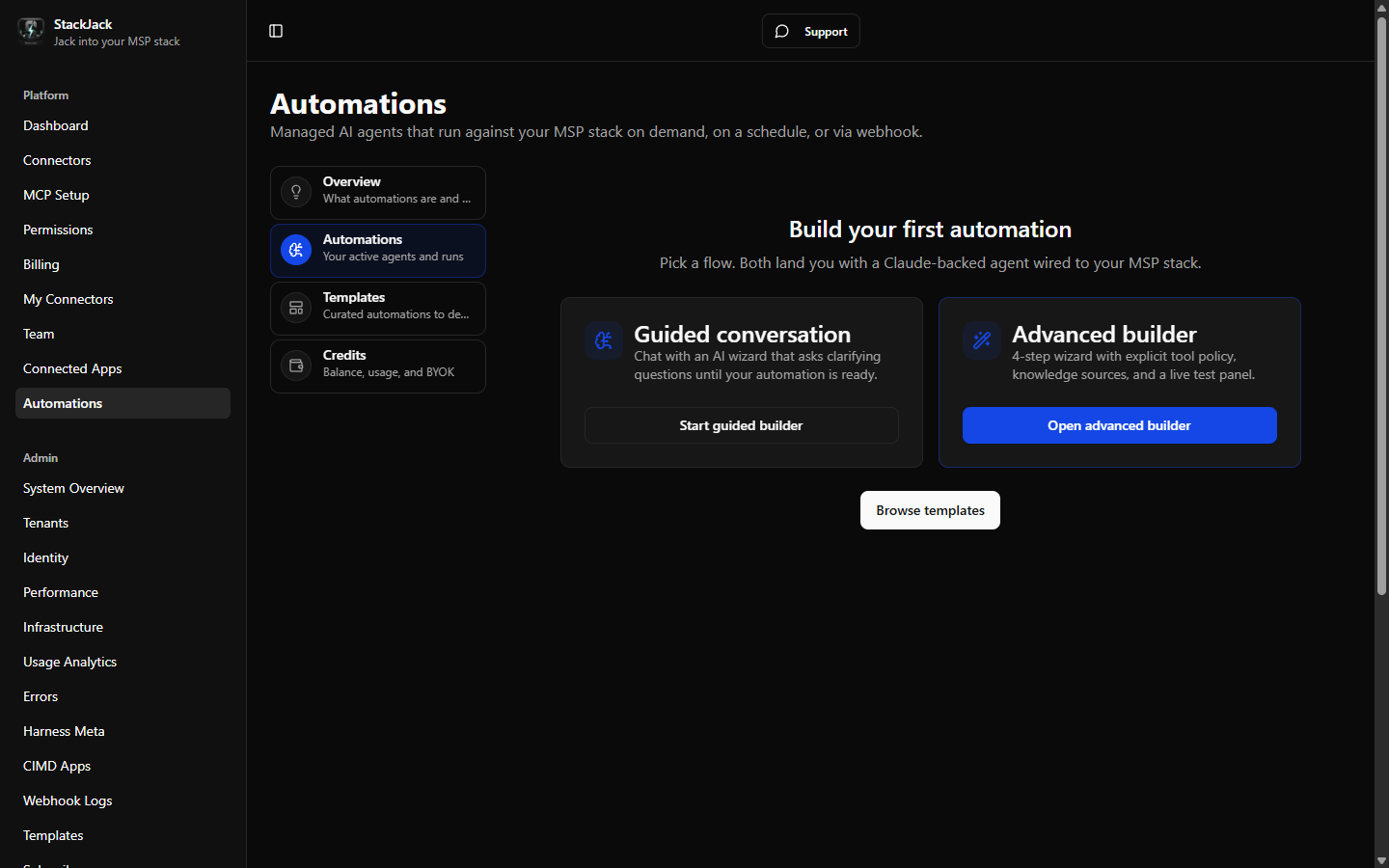 The Automations page with the left rail visible and the Automations tab active, shown here in its first-run empty state with the two build-mode cards. Once you have automations, this area leads with a card grid instead — see below.
The first-visit tour
The first time you open the page, you land on Overview and a short guided tour starts: it walks through the rail, the Overview primer, the Automations list and its filters, the template gallery, and the Credits tab. Steps that do not apply yet (for example, list filters when you have no automations) are skipped. When the tour closes, it tells you it can be replayed via the help icon in the top bar. On later visits the page opens straight to the Automations tab.
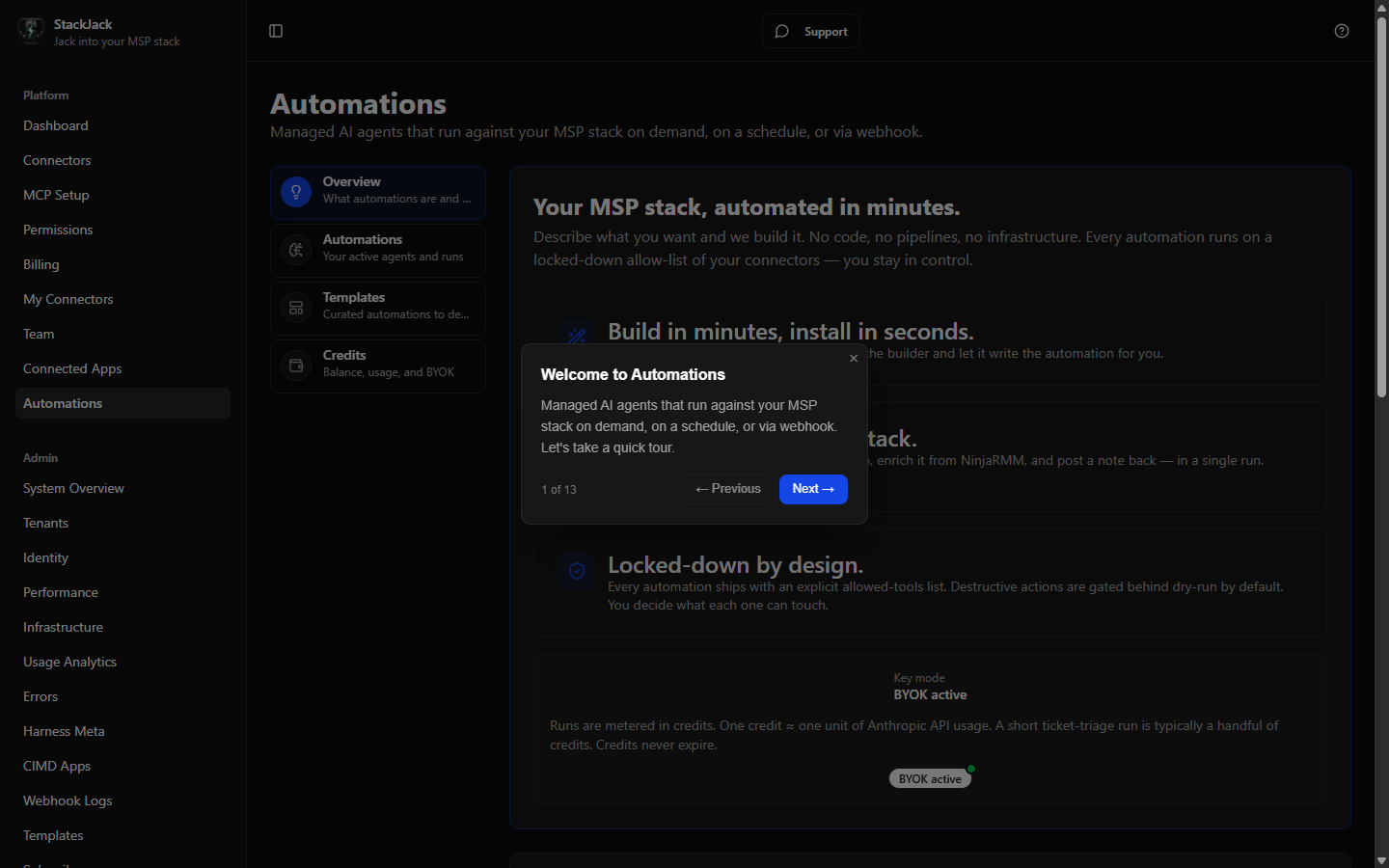 The first-visit tour welcome dialog over the Automations page.
Overview tab
The Overview tab is a reading page:
- A hero card summarizes the value of automations and shows your credit balance. A Buy credits button jumps to the Credits tab — unless your tenant uses BYOK (your own Anthropic key), in which case a "BYOK active" badge appears instead.
- The Understanding Automations primer covers six topics: what an automation is, the three triggers, cost and credits, safety guardrails, the three ways to start (with direct links to Templates, the Wizard, and the Builder), and where to see results.
Automations tab
This is your working list.
When you have no automations yet
You see a "Build your first automation" state with two mode cards and a template link:
- Guided conversation — chat with an AI wizard that asks clarifying questions until your automation is ready. Opens the guided wizard.
- Advanced builder — a four-step builder with explicit tool policy, knowledge sources, and a live test panel. Opens the advanced builder.
- Browse templates — switches to the Templates tab. See Using Automation Templates.
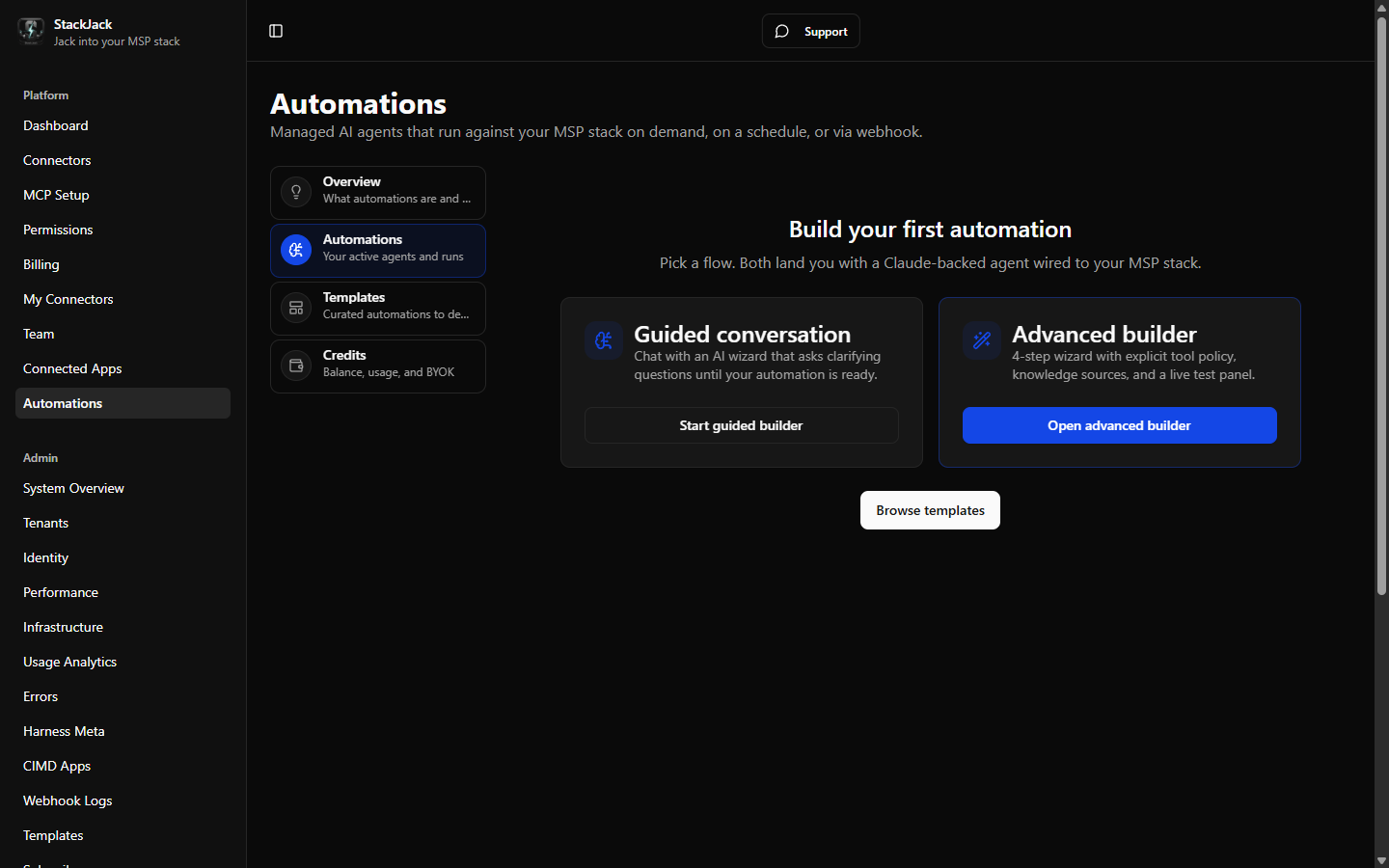 The empty-state "Build your first automation" view with the Guided conversation and Advanced builder mode cards.
When you have automations
Once you have at least one automation, the two build-mode cards give way to an operational list. A header row leads, followed by a search-and-sort row, the filter chips, and your automation cards.
Header. The left side shows Your automations and a count (for example, "3 automations"). The right side has three actions:
- Refresh — re-loads the list and each card's latest run.
- Advanced builder — opens the advanced builder for a new automation.
- New automation — opens the guided wizard.
Search and sort. A search box filters the grid by name or description as you type. A Sort dropdown orders the cards by Last run (most recently run first — the default), Name, or Newest (most recently created first).
Filters. Chips with live counts let you narrow the grid: All, Active, Inactive, Orphaned, and Sync issues. "Sync issues" collects every automation that needs attention to stay in sync (sync needed, schedule drift, or orphaned). If your search and filters match nothing, the grid is replaced with a "No automations match" message and a Clear search & filters button.
Automation cards. Each card leads with the operational picture: the automation's name and description, an Active / Inactive health pill, and — when something needs attention — one or more warning pills. Below that sit the trigger type and Claude model, and a footer showing the last run (its status badge and how long ago it ran, or "No runs yet") with a Runs shortcut straight to the run history.
| Pill | Meaning |
|---|---|
| Active / Inactive | Whether the automation is enabled to run. |
| Consent pending | The autonomous-operation consent has not been accepted yet — the automation cannot run until it is. |
| Orphaned | The automation's remote resources are missing; it cannot run and should be deleted and re-created. |
| Sync needed | The stored configuration is out of sync with the hosted agent; re-sync from the automation's detail page. |
| Schedule drift | A scheduled automation's schedule registration needs repair. |
Click any card (or press Enter/Space with the card focused) to open that automation's detail page.
If the list fails to load, an error banner explains why (for example, the automation service being unreachable) with a Try again button.
Templates tab
The gallery of installable automation templates, with category filters and risk badges. Covered in full in Using Automation Templates.
Credits tab
Your credit balance, credit pack purchases, BYOK key management (Enterprise), and recent transactions. Covered in the credits and billing documentation for automations.